5.0 ★
68 Google reviews

By the Deluxe Smart Film team — reviewed by Awadrey Delgado, founder (500+ switchable film installations in South Florida since 2020) — Updated 18 July 2026

Switchable smart film seems like magic, but it's based on solid, fascinating science. At its core, the technology relies on the manipulation of light through electrical currents.
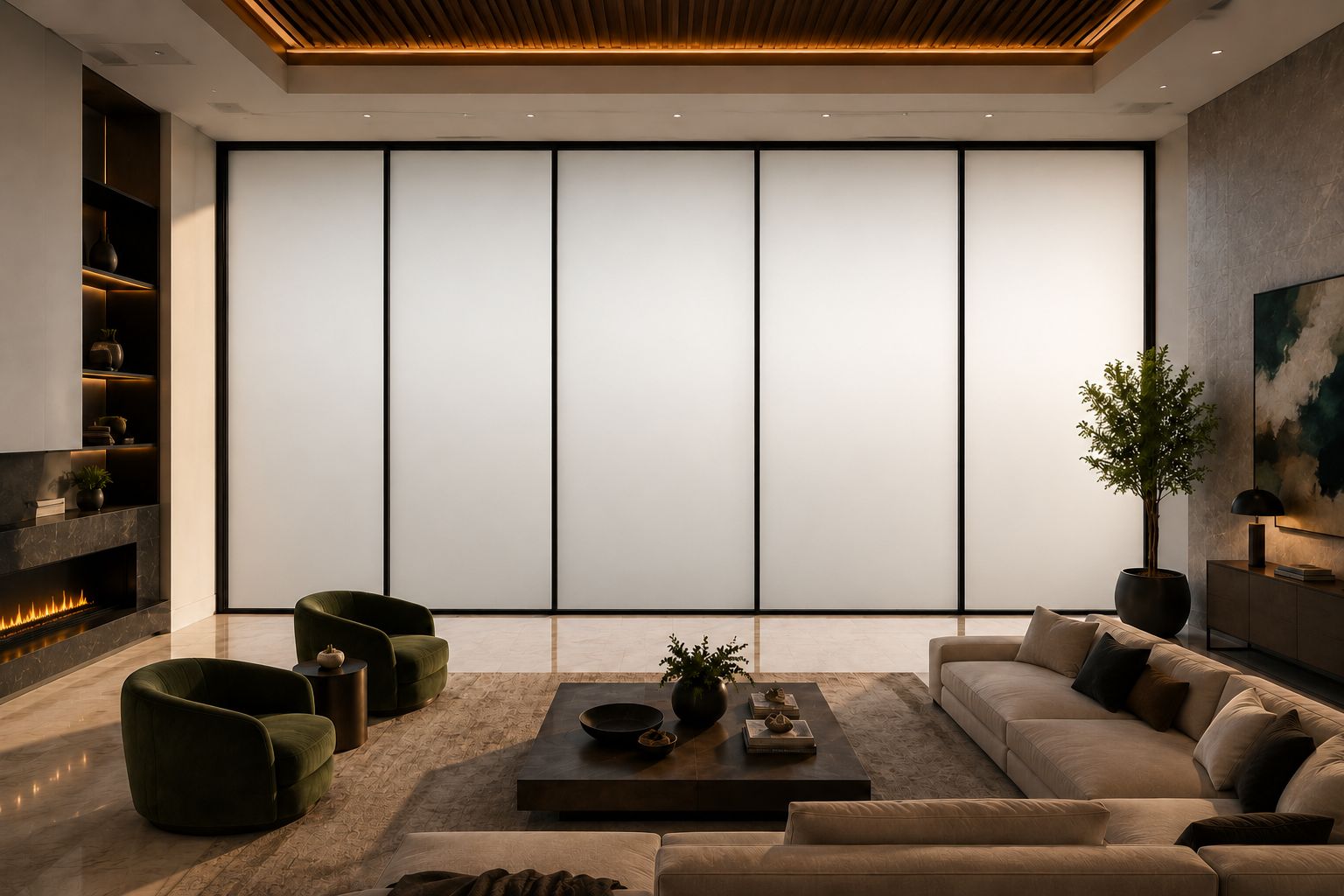
In its natural, unpowered state, the liquid crystal molecules inside the film are scattered randomly. Because they are not aligned, they bounce light in all directions (scattering it). This prevents you from seeing through the glass, creating a frosted, opaque barrier that provides complete visual privacy while still allowing natural ambient light to filter through.
When you flip a switch, press a button on a remote, or use a smartphone app, a low-voltage electrical current is sent through the conductive layers of the film. This electrical field forces the liquid crystal molecules to snap into alignment. With the molecules perfectly lined up, light can pass straight through without being scattered, making the glass instantly transparent.
A standard smart film installation includes:
Understanding how switchable smart film works demystifies the technology and highlights its reliability. It's a brilliant application of physics and materials science that brings dynamic control to everyday glass surfaces.
Explore the incredible speed of PDLC technology. Find out why the transition is nearly instantaneous and how it benefits your daily life.
HistoryTrace the origins of smart glass from early laboratory experiments to the sleek, reliable architectural solutions available today.
ScienceA deeper look into the chemistry and physics of PDLC technology. Learn how polymers and liquid crystals interact to create dynamic glass.
PRIVACY. CONTROL. MODERN LIVING.
Premium smart film professionally installed on your existing glass. No blinds. No curtains. Just instant privacy.
Get My Free EstimateMost projects run $55-$90 per sq ft installed. See your range before you give us your number.
5.0 ★
68 Google reviews
500+
installations
2-year
warranty