5.0 ★
68 Google reviews
By the Deluxe Smart Film team — reviewed by Awadrey Delgado, founder (500+ switchable film installations in South Florida since 2020) — Updated 7 September 2026
PDLC smart film draws roughly 0.3 to 0.5 watts per square foot while it is clear and nothing while it is frosted. A 40 square foot shower enclosure uses about 15 to 20 watts when clear — less than a single LED bulb — and a 150 square foot conference-room wall about 60 to 75 watts. At Florida's average rate of about 15 cents per kilowatt-hour, a bathroom panel that is clear eight hours a day adds well under $1 a month; a conference room clear all business day adds about $2 to $3. Running cost is not a reason to hesitate.
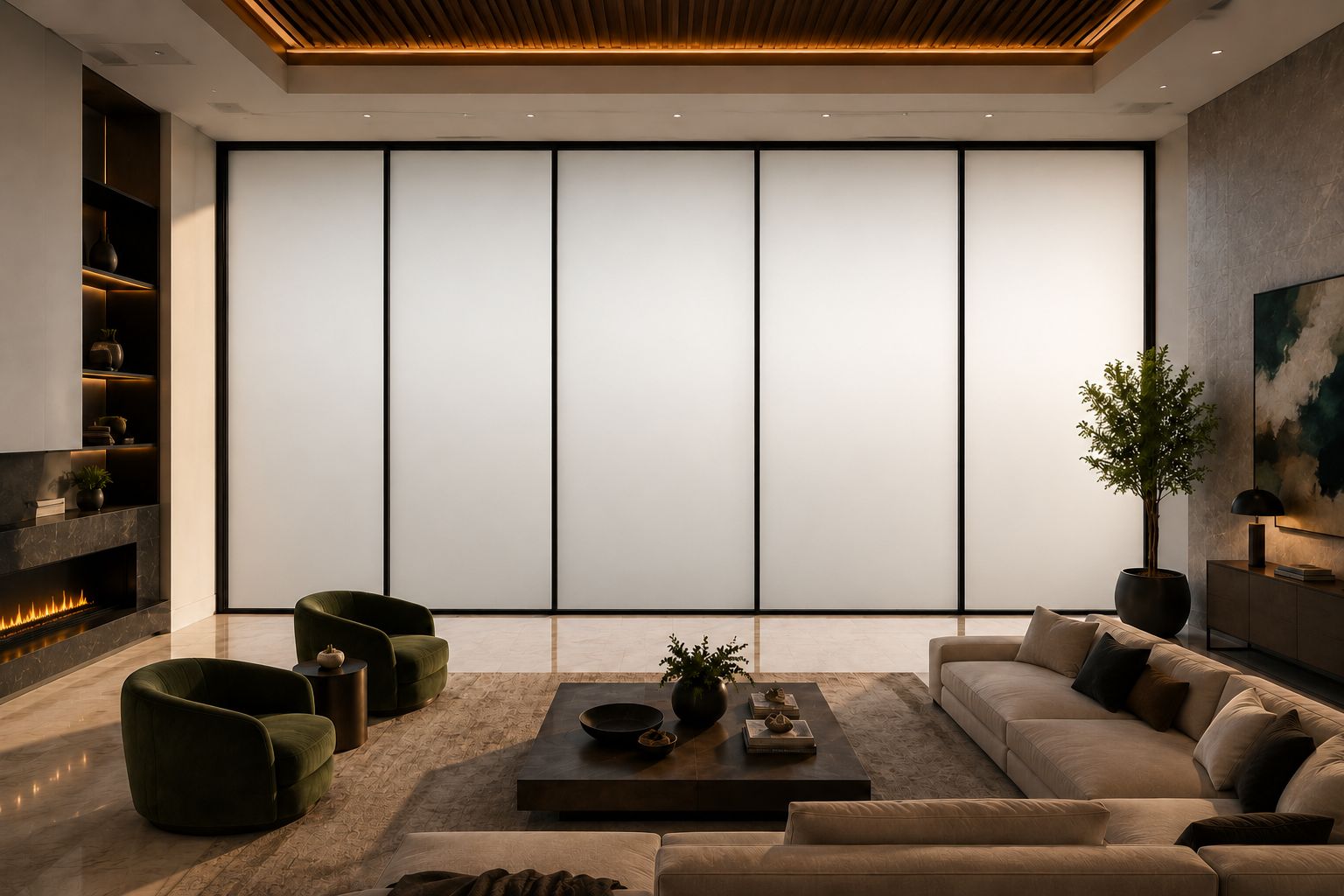
PDLC stands for polymer dispersed liquid crystal. With no voltage, the liquid-crystal droplets sit randomly and scatter light — that is the frosted state, and it costs nothing to hold. When the transformer applies low-voltage AC, the droplets align and light passes straight through — the clear state. The film only consumes power while aligned. This is also why smart film fails to frosted in a power cut: privacy is the default.
A bathroom window (10 sq ft): about 5 W clear; a few cents a month.
A frameless shower (30 to 40 sq ft): 15 to 20 W clear; under $1 a month even if clear all day.
A two-panel sliding door (50 to 60 sq ft): 25 to 30 W clear; about $1 a month clear 8 hours a day.
A conference room wall (100 to 200 sq ft): 50 to 100 W clear; $2 to $4 a month across a business week.
A storefront (300 sq ft): 150 W clear; about $5 a month if clear during opening hours.
Compare that with a bathroom exhaust fan (30 to 60 W) or a small TV (50 to 100 W).
The film is driven by a low-voltage transformer that plugs into a standard 110 V outlet and outputs 48 to 65 volts AC. Transformers are sized to the film area; a typical residential unit is rated 50 to 100 W and idles at about 1 W when the film is frosted. It lives in a vanity, closet or ceiling space and is covered by our two-year warranty.
No. Film is rated in tens of thousands of switching cycles and in powered hours far beyond a decade of normal use. Leaving a conference-room wall clear all day is normal use. What shortens film life is moisture at an unsealed edge and heat on sun-facing glass, not electricity — see our guide on how long smart film lasts.
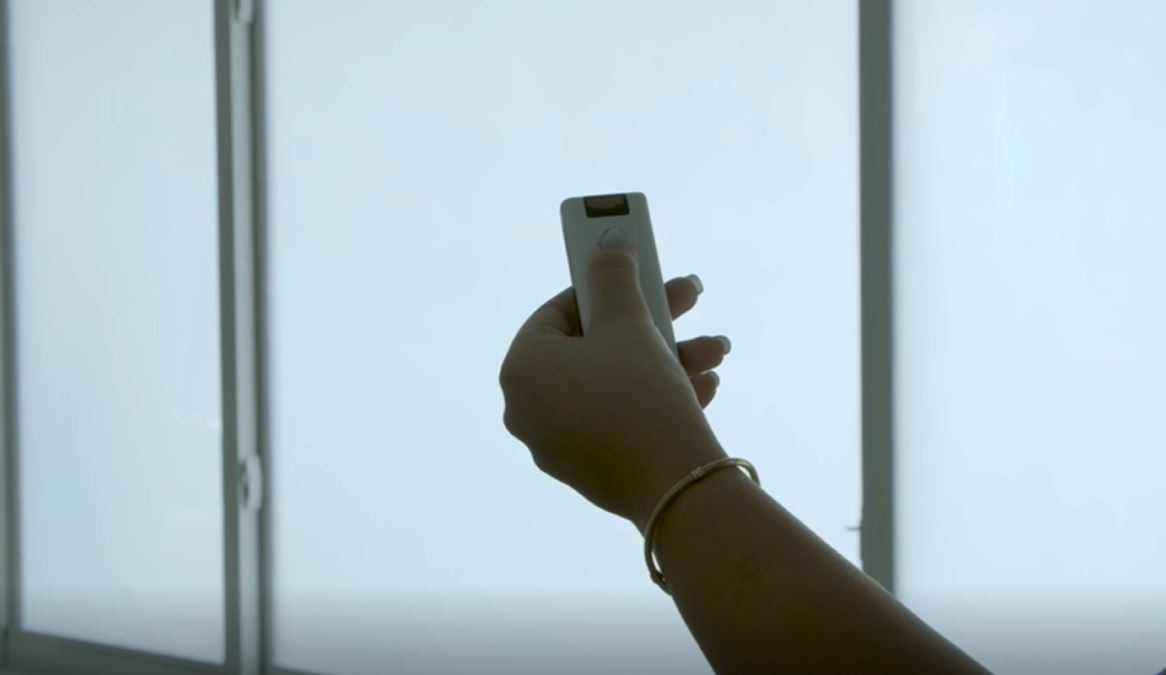
Because the draw is small, there is no energy reason to automate it, but many clients frost rooms on a schedule for privacy — bathrooms at night, offices at closing. We set that up with a smart switch, Alexa or Google Home, or the building's control system.
How long smart film lasts → lifespan guide. Pricing → smart film cost. Free quote → request one here.
A deeper look into the chemistry and physics of PDLC technology. Learn how polymers and liquid crystals interact to create dynamic glass.
GuidesWall switch, RF remote, Alexa or Google smart switch, sensor or timer: how each smart film control option is set up and what it costs.
EducationWe debunk the most frequent misconceptions about smart film, from electricity costs to maintenance requirements.
PRIVACY. CONTROL. MODERN LIVING.
Premium smart film professionally installed on your existing glass. No blinds. No curtains. Just instant privacy.
Get My Free EstimateMost projects run $55-$90 per sq ft installed. See your range before you give us your number.
5.0 ★
68 Google reviews
500+
installations
2-year
warranty